Vol. 6 No. 1 (2026): Theology in Dialogue with Culture, Technology, and Human Vulnerability
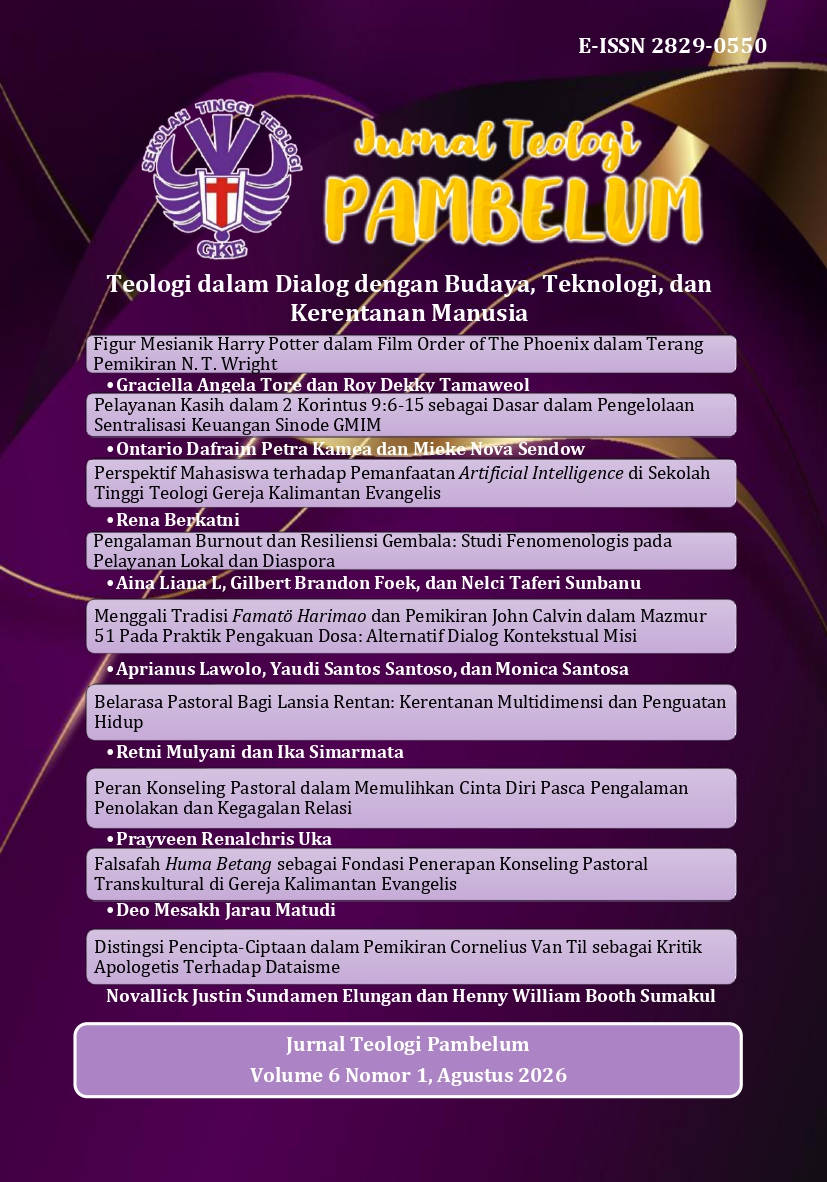
Praise and thanks be to Jesus Christ. With His grace, Jurnal Teologi Pambelum Volume 6, Number 1 (August 2026) is once again published. This edition presents nine articles that illustrating the true dynamics of theology. Theology not only addresses doctrine, but also engages in dialogue with culture, critically examines techological and responds to the experience of human vulnerability. Author demographics in this issue: 6 Universities, 5 Provinces, 1 Country.
The first article, “The Messianic Figure of Harry Potter in the Film Order of the Phoenix in the Light of N. T. Wright’s Thought” by Graciella Angela Tore and Roy Dekky Tamaweol, reexamines the character of Harry Potter to demonstrate a significant connection between messianic concepts in theology and portrayals of leadership in popular culture.
The second article, “The Love-Based Ministry in 2 Corinthians 9:6–15 as the Foundation for the GMIM Financial Centralization Management” by Ontario Dafraim Petra Kamea and Mieke Nova Sendow, explores the principle of the ministry of love in 2 Corinthians 9:6–15. Paul’s teaching on giving with joy, willingness, and faith has strong relevance for contemporary church financial management practices, including the management of centralized finances.
The third article, “Students’ Perspectives on the Use of Artificial Intelligence at the Sekolah Tinggi Teologi Gereja Kalimantan Evangelis” by Rena Berkatni, emphasizes that AI is beneficial for learning and ministry, but must be used wisely, ethically, and responsibly without replacing the role of humans or spiritual values.
The fourth article, “Pastors’ Experiences of Burnout and Resilience: A Phenomenological Study of Local and Diaspora Ministry” by Aina Liana L, Gilbert Brandon Foek, and Nelci Taferi Sunbanu, argues that burnout is a multidimensional pastoral disruption, while pastoral resilience is shaped through the interaction of theological, psychological, relational, and organizational resources in accordance with the context of their ministry.
The fifth article, “Exploring the Famatö Harimao Tradition and John Calvin's Thought in Psalm 51 on the Practice of Confession: An Alternative for Contextual Mission Dialogue” by Aprianus Lawolo, Yaudi Santos Santoso, and Monica Santosa, integrates the Famatö Harimao tradition with Psalm 51 to provide a proper understanding of the purpose and meaning of confession within the Famatö Harimao practice.
The sixth article, “Pastoral Care for Vulnerable Elderly: Multidimensional Vulnerability and Life Strengthening” by Retni Mulyani and Ika Simarmata, proposes pastoral care for vulnerable elderly through relational and sustained presence, a dialogical process of meaning-making, and the formation of a responsible community habitus.
The seventh article, “The Role of Pastoral Counseling in Restoring Self-Love After Experiences of Rejection and Relationship Failure” by Ambarwaty Pratiwi I.P. Taturu and Julio Eleazer Nendissa, examines the contribution of pastoral counseling in rebuilding a wounded sense of self through a theological-anthropological approach that affirms human dignity as imago Dei.
The eighth article, “Philosophy of Huma Betang as The Foundation of Transcultural Pastoral Counseling Implementation in Kalimantan Evangelical Church” by Deo Mesakh Jarau Matudi, identifies an organic continuity between the values of huma betang and the principles of transcultural pastoral counseling.
The ninth article, “The Creator-Creation Distinction in the Thought of Cornelius Van Til as an Apologetic Critique of Dataism” by Novallick Justin Sundamen Elungan and Henny William Booth Sumakul examines Dataism’s ontological and epistemological claims regarding reality, humanity, and truth, and then critically evaluates them through the framework of the Creator-creation distinction formulated by Cornelius Van Til.
The articles in this issue as a whole demonstrate that theology is constantly in dialogue with various realities of life. This dialogue takes place through encounters with popular culture and local wisdom, technological developments, church governance, and even experiences of human vulnerability—both in personal life and in ministry. Theology does not remain merely a conceptual discourse but, in a contextual sense, becomes a reflection of faith that helps the church and its congregation understand and respond to the changing times while remaining rooted in God’s Word and respect for human dignity.
This issue is intended to deepen academic reflection, broaden the dialogue between theology, culture, technology, and other disciplines, and strengthen the church’s ministry practices. May the various ideas presented here inspire and encourage the emergence of contextual, responsible, and compassionate ministry amid the dynamics of contemporary life. Enjoy your reading!
Warm regards, Lia Afriliani, M.Th. Editor-in-Chief, Jurnal Teologi Pambelum
 Abstract View: 114,
  PDF (Bahasa Indonesia) Download: 95