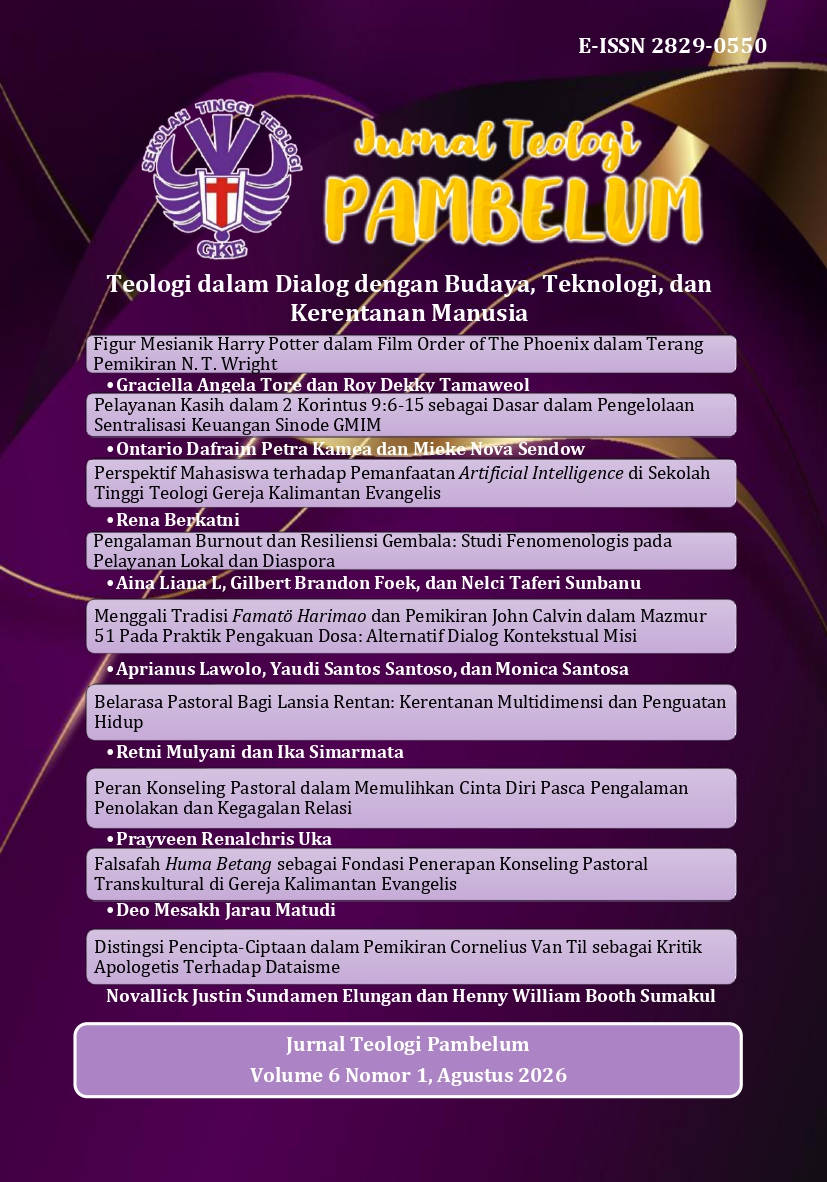
Pastoral Care for Vulnerable Elderly: Multidimensional Vulnerability and Life Strengthening
DOI:
https://doi.org/10.59002/jtp.v6i1.209Keywords:
belarasa pastoral; lansia; reframing; kerentanan; komunitasAbstract
This study aims to examine the multidimensional vulnerability of the elderly in the GKE Panenga Congregation and to formulate relevant pastoral care practices to strengthen their lives. The study employs a qualitative approach using a case study design focused on two vulnerable elderly individuals, JH and MG. Data were collected through in-depth interviews and observations of the elderly, as well as interviews with family members and church ministers. The results indicate that the vulnerabilities of JH and MG are multidimensional, varying in form and intensity. These include physical limitations, functional dependence, economic conditions, limited social relationships and access to church life, as well as spiritual struggles in making sense of illness, dependence, and old age. Family support serves as an important source of strength, but it does not always replace the need for the presence of a faith community. The study also found that ministry to the elderly that relies on church-based activities and depends on the initiative of specific individuals has not fully reached elderly individuals with limited mobility. This study affirms that pastoral compassion must be realized through relational and sustained presence, a dialogical process of meaning-making, and the formation of a communal habitus that is accountable to vulnerable elderly people. The recommended pastoral practices include relational home visits, worship services and sacraments for the elderly who are unable to attend, reframing conversations, family counseling, and the formation of visiting teams and a culture of prayer for the elderly. Thus, strengthening the lives of the elderly is not understood as the elimination of frailty, but rather as the preservation of dignity, the meaning of life, relationships, and connectedness with the faith community amid the limitations of old age.
References
Capps, D. (1990). Reframing: A New Method in Pastoral Care. Fortress Press.
Emzir. (2014). Metodologi Penelitian: Analisis Data(Model Bogdan&Biklen, Model Miles & Hubermann, Model Strauss & Corbin, Model Spradley, Analisis Isi Model Philip Mayring, Program Komputer NVivo). Rajawali Press.
Gintings, E. . (2011). Metode Studi Pastoral. Jurnal Info Media.
Jenny Huberta Kotta, C., Erastus, S., Santoso, S., Michael Najoan, J., & Martin Tamera, D. (2024). Pendekatan Konseling Pastoral Bagi Lansia Yang Mengalami Loneliness. Vox Dei: Jurnal Teologi dan Pastoral, 5(1 SE-Articles), 97–115. https://doi.org/10.46408/vxd.v5i1.499
Keloso, Afriliani, L., & Berkatni, R. (2025). The Church and Holistic Health Care for the Elderly: A Study of the GKE Eppata and GKE Eben Ezer Congregations in Banjarmasin. Jurnal Teologi Pambelum, 5(1), 47–66. https://doi.org/10.59002/jtp.v5i1.157
Mezak, W. (2024). Pastoral Konseling sebagai Kebutuhan Pendampingan Kepada Jemaat Lanjut Usia. AISTHETIKOS Jurnal Ilmu Teologi dan Seni, 1(1 SE-Articles), 11–18. https://doi.org/10.70420/aisthetikos.v1i1.262
Moleong, L. J. (1989). Metodologi Penelitian Kualitatif. Remaja Rosdakarya.
Nasution. (1996). Metode Research: Penelitian Ilmiah. Bumi Aksara.
Nouwen, H. J. M., McNeil, D. P., & Morrison, D. A. (1982). Compassion: A Reflection on the Christian Life. Doubleday.
Zylla, P. C. (2012). The Roots of Sorrow: A Pastoral Theology of Suffering. Baylor University Press.
Zylla, P. C. (2017). Inhabiting compassion: A pastoral theological paradigm. HTS Teologiese Studies/Theological Studies, 73(4), 1–9. https://doi.org/10.4102/hts.v73i4.4644
Downloads
Published
How to Cite
Issue
Section
License
Copyright (c) 2026 Retni Mulyani, Ika Simarmata

This work is licensed under a Creative Commons Attribution 4.0 International License.