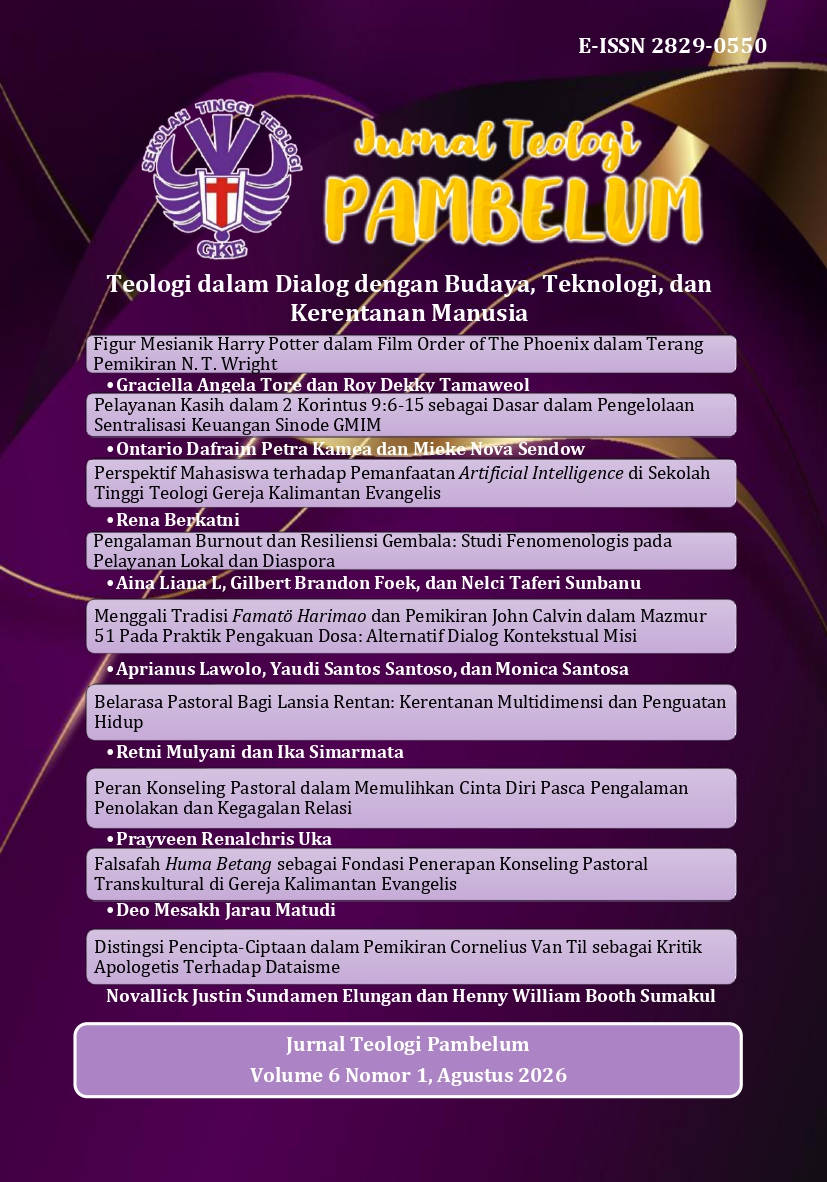
The Love-Based Ministry in 2 Corinthians 9:6–15 as the Foundation for the GMIM Financial Centralization Management
DOI:
https://doi.org/10.59002/jtp.v6i1.184Keywords:
Love-Based Ministry, GMIM Financial Centralization, Joyful Giving.Abstract
This study examines how the principle of loving service in 2 Corinthians 9:6–15 can serve as a theological foundation for the centralized financial management system of the Gereja Masehi Injili di Minahasa (GMIM). The research focuses on the application of biblical values such as joyful, willing, and sincere giving within a church financial structure that requires accountability and transparency. A qualitative approach is employed through library research using a historical-critical hermeneutical method to explore the context and theological message of the text. The novelty of this study lies in its integration of Paul’s teaching on loving service with the administrative practice of centralized church finance. The findings indicate that sincere and voluntary giving can function as an ethical foundation for financial management, strengthening congregational solidarity, fostering trust, and supporting accountable use of funds for sustainable church ministry.
References
Banks, R. (2008). Redeeming the Routines: Church, Leadership and the Power of Everyday Life. SPCK.
Barclay, W. (t.t.). Pemahaman Alkitab Sehari-hari: 1&2 Korintus.
Betz. (1993). 2 Korinther 8 und 9.
Beyer, U., & Simamora, E. (2020). Memberi dengan Sukacita. BPK Gunung Mulia.
Campbell, D. A. (2020). Paulus Perjalanan Seorang Rasul. BPK Gunung Mulia.
Carson, D. A., France, R. T., & others. (2017). Tafsiran Alkitab Abad ke-21 Jilid 3: Matius – Wahyu. Yayasan Komunikasi Bina Kasih.
Drane, J. (2013). Memahami Perjanjian Baru: Pengantar Historis-Teologi. BPK Gunung Mulia.
Fee, G. D. (1987). The First Epistle to the Corinthians. Eerdmans.
GMIM. (2021a). 8 Halaman Perbendaharaan Sinode GMIM (revisi 29 Juli 2021) (hlm. 66–67).
Hughes, R. K. (2006). 2 Corinthians Power In Weakness. Crossway Books.
Marbun, P. (2019). Mengelola Keuangan Gereja Secara Sehat. Akademi Teologi GMIM.
Marxsen, W. (t.t.). Unknown Title.
Maryono, P. (2016). Gramatikal dan Sintaks Bahasa Yunani Perjanjian Baru. STTII Yogyakarta.
Moleong, L. J. (1989). Metode Penelitian Kualitatif. Remaja Rosdarya.
Murray, H. (2005). The Second Epistle to the Corinthians.
Noordegraf, A. (2017). Orientasi Diakonia Gereja: Teologi dalam Perspektif Reformasi. BPK Gunung Mulia.
Omanson, R., & Ellington, J. (2013). Surat Paulus ke-2 kepada Jemaat Korintus: Pedoman Penafsiran Alkitab. Lembaga Alkitab Indonesia.
Panggabean, J. (2018). Keterbukaan Budaya Lokal dalam Akuntabilitas Keuangan Gereja Kristen. Jurnal Manajemen & Pelayanan Gereja, 3(1), 78.
Spittler, R. P. (2001). Pertama dan Kedua Korintus. Gandum Mas.
Stott, J. (1995). The Message of 2 Corinthians: Power in Weakness. IVP.
Sutanto, H. (1993). Hermeneutik: Prinsip dan Metode Penafsiran Alkitab. SATT.
Usman, H. (2001). Metodologi Penelitian. Bumi Aksara.
Downloads
Published
How to Cite
Issue
Section
License
Copyright (c) 2026 Ontario Dafraim Petra Kamea, Mieke Nova Sendow

This work is licensed under a Creative Commons Attribution 4.0 International License.