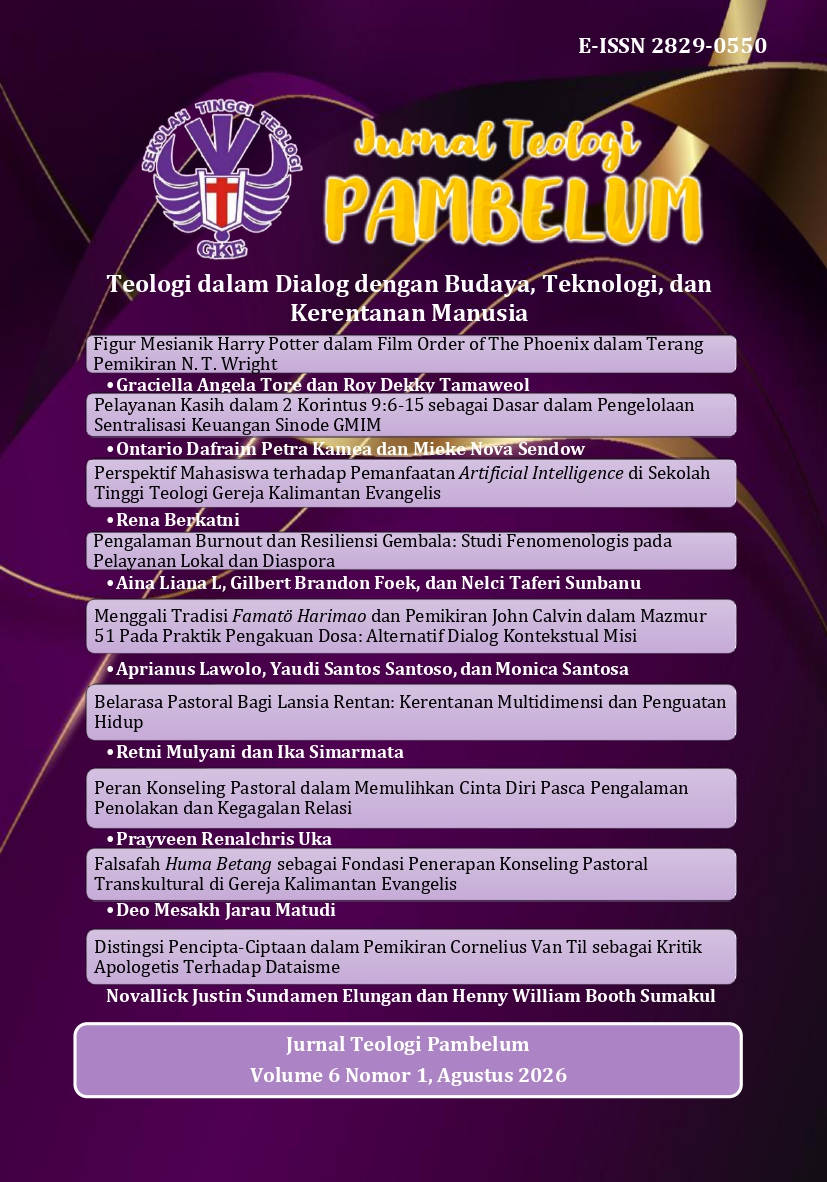
Exploring the Famatö Harimao Tradition and John Calvin's Thought in Psalm 51 on the Practice of Confession: An Alternative for Contextual Mission Dialogue
DOI:
https://doi.org/10.59002/jtp.v6i1.127Keywords:
Famatö Harimao, John Calvin, Contextualization, Psalm 51, MissionAbstract
This article investigates the understanding of confession based on John Calvin's perspective in Psalm 51 and the Famatö Harimao Culture of the Nias Tribe. The purpose of this research is to find the ideas of Calvin especially in the context of confession, the use of sacrifice can be interacted and discussed with the tradition of Famatö Harimao which is believed to be a place to confess sins so as to find the value of understanding that can enrich both ideas and determine the attitude towards the practice of Famatö Harimao. Using a comparative and contextual approach, this research will identify similarities and differences between the two ideas. Such as the concept of a transcendent person, the concept of love from confession, the concept of salvation, and the concept of ritual become the means to enrich each idea. The differences arising from the conceptual framework, emphasis on means, emphasis on goals, and aspects of community can be an alternative for a logical and meaningful dialogue. The contribution of this research is to provide a contextual dialogue for the Nias Tribe, especially the Famatö Harimao tradition which has a high religious value. Furthermore, Calvin's thoughts will not eliminate local culture but provide a new transformation of understanding about the purpose and direction of confession.
References
Beach, J. M. (2017). The Idea of “A General Grace of God” In Calvin and Some of His Reformed Contemporaries. MAJT, 28.
Calvin, J. (n.d.). Commentary on Psalms - Volume 2. Grand Rapids, MI: Christian Classics Ethereal Library.
Calvin, J. (2015). Repentance. Monoergism Books.
Dane, T. L. (2006). The Life, And Theological Method Of John Calvin. Baptist Bible Seminary.
Duha, A., & Nduru, K. (2022). Nilai-Nilai Pendidikan Karakter Yang Terdapat Dalam Buku Famatö Harimao Karya P. Johannes M. Hammarle, OFM. CAP. Kohesi: Jurnal Pendidikan Bahasa Dan Sastra Indonesia, 3(1).
Florovsky, G. (1974). Christianity and Culture. In Nordland Publishing Company.
Garner, D. B. (2017). Pertahuran Penting: Hermeneutika Insiders Movement Dan Injil. Verbum Christi, 3(2).
Gulo, I. D., & Panjaitan, F. (2022). Konsep Penebusan Dosa dalam Bilangan 21 : 4-9 dalam Wujud Budaya Famatö Harimao bagi Masyarakat Nias. Sanctum Domine: Jurnal Teologi, 12(1), 17–34. https://doi.org/10.46495/sdjt.v12i1.133
Hall, D. W. (2011). Calvin Di Ranah Publik Demokrasi Liberal, Hak Asasi, dan Kebebasan Sipil. Momentum.
Harita, A. (2014). Famadaya Harimao Dalam Kehidupan Masyarakat Maenamölö Kabupaten Nias Selatan Kepulauan Nias (Kajian Sejarah Seni). Universitas Sumatera Utara.
Harun, M. (2016). Perjumpaan Injil Dan Kebudayaan Dalam Kerasulan Paulus. STUDIA Philosophica et Theologica, 16(1), 1–16.
Joannes Paulus PP. II. (1982). Letter of Foundation. Dicastery For Culture And Education . https://www.cultura.va/content/cultura/en/magistero/papa/JohnPaulII/fondazione.html
Manetsch, S. M. (2018). John Calvin’s Doctrine of The Christian Life. JETS, 61(2), 259–273.
Ndruru, S. A. J., & Panjaitan, F. (2021). Korelasi Konsep Sunat Dalam Perjanjian Lama Dengan Budaya Sunat Di Masyarakat Nias. Jurnal Misioner, 1(2), 140–160.
Setiawan, D. E. (2020). Menjembatani Injil dan Budaya dalam Misi Melalui Metode Kontektualisasi. Fidei: Jurnal Teologi Sistematika Dan Praktika, 3(2), 160–180. https://doi.org/10.34081/fidei.v3i2.132
Soegianto. (2024). The Relationship between the Gospel and Culture: A Theological Analysis and Social Perspective in a Contemporary Context. Theological Journal Kerugma, 7(2), 84–92. https://doi.org/10.33856/kerugma.v7i2.428
Suzuki, P. (1959). The Religious System and Culture of Nias, Indonesia. Excelsior. https://books.google.co.id/books?id=5NEdAAAAMAAJ
Downloads
Published
How to Cite
Issue
Section
License
Copyright (c) 2026 Aprianus Lawolo, Yaudi Santos Santoso, Monica Santosa

This work is licensed under a Creative Commons Attribution 4.0 International License.