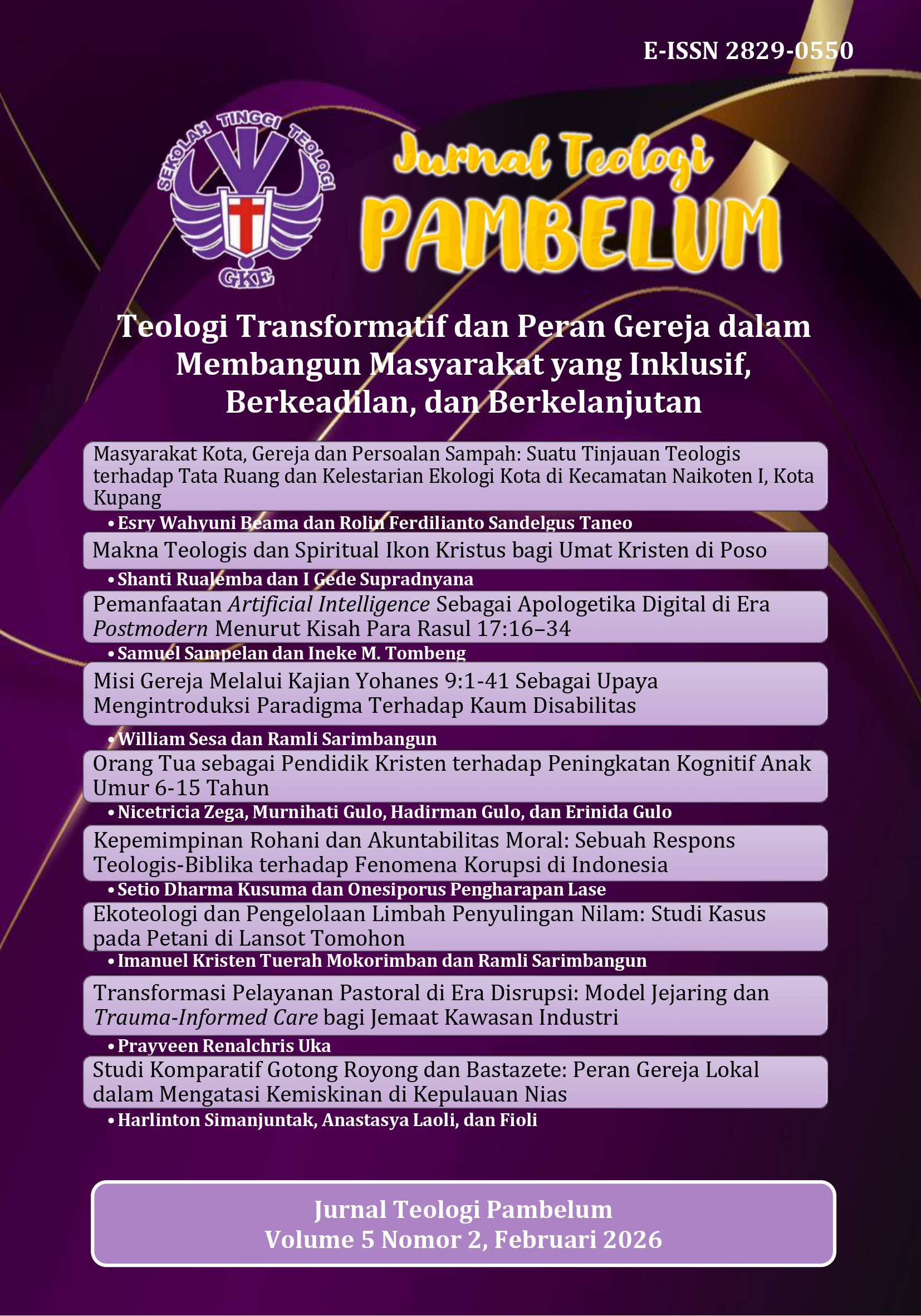
A Comparative Study of Gotong Royong and Bastazete: The Role of Local Churches in Poverty Alleviation in the Nias Islands
DOI:
https://doi.org/10.59002/jtp.v5i2.141Keywords:
Culture of Mutual Aid, Role of the Local Church, Poverty Alleviation, Nias, BastazeteAbstract
Poverty in Indonesia, particularly in Nias, is a complex issue related to access to education, unemployment, and access to the workforce. These four aspects are interrelated, forming a complex cycle that is difficult to break. This study aims to identify the role of the local church in poverty alleviation in Nias through the integration of Christian values, particularly based on the principle of bastazete in Galatians 6:2, with the culture of mutual cooperation that is deeply rooted in Indonesian society. A comparative theological-anthropological study has never been conducted before, creating an opportunity to explore how the integration of theology and anthropology can drive the church's role in addressing social issues within society. Using a comparative-integration approach, this study found that the local church in Nias has strategic potential to become an agent of change through education and community empowerment programmes based on Christian values and the culture of mutual cooperation. This integration not only offers practical solutions to poverty but also strengthens the role of the church in the local and even global context. Practically, this research contributes conceptual frameworks for local churches to become agents of change through theological and practical approaches.
References
Bible Hub: Search, Read, Study the Bible in Many Languages. (n.d.). https://biblehub.com/
Dedy Sasongko. (2020). Strategi Membangun Indonesia Maju. djkn.kemenkeu.go.id. https://www.djkn.kemenkeu.go.id/kanwil-kalbar/baca-artikel/13347/Strategi-Membangun-Indonesia-Maju.html
Djatmiko, G. P., & Hauw, A. (2022). Konsep Teologis Tolong Menolong Menurut Galatia 6:2 Ditinjau dari Makna Kata ΒΆΡΟΣ dan Etos Timbal Balik pada Budaya Yahudi dan Yunani-Romawi di Jemaat Galatia. Jurnal Amanat Agung2, 18(2), 183–218. https://ojs.sttaa.ac.id/index.php/JAA/article/view/553/419
Groenen, C. (1991). Pengantar ke dalam Perjanjian Baru. Kanisius.
Hia, N. B., Malau, F., Zebua, A. K., Gea, H. N., & Febryani, A. (2021). Praktik Enkulturasi Nilai Keluhuran Gotong Royong pada Budaya Tolo-tolo Etnik Nias di Desa Fadorosifulubanua Kecamatan Mandrehe Barat. Buddayah: Jurnal Pendidilkan Antropologi, 3(2), 93–102. https://jurnal.unimed.ac.id/2012/index.php/bdh/article/view/33114
Kusnandar, V. B. (2021). Angka Kemiskinan di Kepulauan Nias Tertinggi di Sumatera Utara (Annisa Mutia (Ed.)). databoks.katadata.co.id. https://databoks.katadata.co.id/demografi/statistik/61a9531f550bba3/angka-kemiskinan-di-kepulauan-nias-tertinggi-di-sumatera-utara#:~:text=Diikuti Kabupaten Nias Utara dengan,Nias sebesar 16%2C82%25
Kusnandar, V. B. (2022). Berapa Jumlah Penduduk di Kepulauan Nias? (Annisa Mutia (Ed.)). databoks.katadata.co.id. https://databoks.katadata.co.id/demografi/statistik/be21c31d183ffd4/berapa-jumlah-penduduk-di-kepulauan-nias
Lase, I. P. S., Kertih, W., & Mudana, W. (2025). Tradisi Fakosi di Nias: Kajian Nilai Filosif dan Sosio-Kultural sebagai Pendekatan Etnopedagogi pada Pembelajaran Ekonomi. Arthaniti Studies, 6(1), 35–45. https://ojs.mahadewa.ac.id/index.php/arthaniti/article/view/4419
Marhayati, N. (2021). Internalisasi Budaya Gotong Royong Sebagai Identitas Nasional. Jurnal Pemikiran Sosiologi, 8(1), 21–42. https://jurnal.ugm.ac.id/jps/article/view/68407/pdf
Ombo, M. C. N. (2022). Pertentangan Kelompok di Jemaat Galatia: Analisis Hermeneutik dengan Pendekatan Teori Kelas Karl Marx dalam Galatia 3: 15 - 29. Universitas Kristen Satya Wacana.
Ramdhani, S., & Risladiba. (2022). Famasulö: Tradisi, Solidaritas, dan Kemiskinan Keluarga di Nias. Umbara: Indonesian Journal of Anthropology, 7(2), 39–49. https://doi.org/10.24198/umbara.v7i2.38507
Sibagariang, J. S. (2024). Kemiskinan dan Ketidakadilan: Kajian Etis Teologis tentang Kemiskinan sebagai Akibat Ketidakadilan. Jurnal Gamaliel: Teologi Praktika, 6(2), 103–117. https://jurnal.stt-gamaliel.ac.id/index.php/gamaliel/article/view/281/70
Sinaga, M., Damanik, S. W. H., Zalukhu, R. S., Hutauruk, R. P. S., & Collyn, D. (2023). Pengaruh Pendidikan, Pendapatan Per Kapita dan Pengangguran terhadap Kemiskinan di Kepulauan Nias. EKUILNOMI: Jurnal Ekonomi Pembangunan, 5(1), 140–152. https://doi.org/10.36985/a4tg4s88
Zagoto, S. E. P., Nasution, M. A. R., Irsad, Usrah, C. R. Al, & Akbar, K. (2023). Pengaruh Pengangguran dan Pertumbuhan Penduduk Terhadap Tingkat Kemiskinan di Kabupaten Sekepulauan Nias. Jurnal Ilmu Sosial dan Ilmu Politik Malikussaleh (JSPM), 4(1), 14–21. https://doi.org/10.29103/jspm.v4i1.9689
Zendrato, F., & Lubis, I. (2024). Analisis Faktor-Faktor yang Mempengaruhi Kemiskinan di Kepulauan Nias. EKUILNOMI: Jurnal Ekonomi Pembangunan, 6(2), 194–200. https://doi.org/10.36985/napv2g13
Downloads
Published
How to Cite
Issue
Section
License
Copyright (c) 2026 Harlinton Simanjuntak, Anastasya Laoli, Fioli

This work is licensed under a Creative Commons Attribution 4.0 International License.